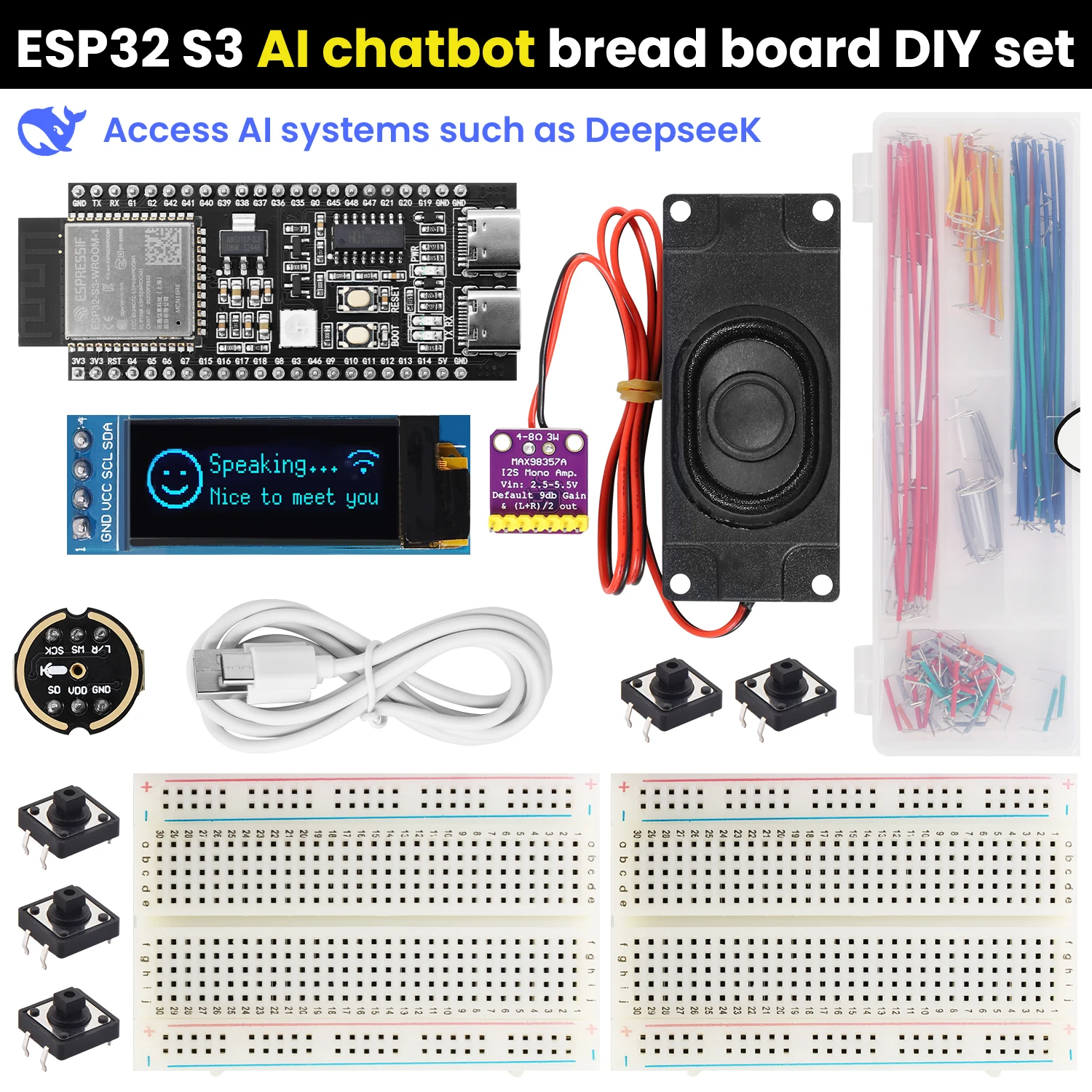
Keyestudio Xiao Zhi AI Voice Interact Chatbot Breadboard DIY Electronic Kit Base on Arduino ESP32-S3-DevKitC-1 Development Board
You will be redirected to AliExpress to complete your purchase
Specifications
- Brand Name
- keyestudio
- Origin
- Mainland China
- High-concerned chemical
- None
- Condition
- New
- Type
- Voltage Regulator
- Supply Voltage
- 1.8V ~ 3.3V
- is_customized
- Yes
- Operating Temperature
- 0-40
- Application
- Speaker
- OLED Resolution
- 128*32
- OLED Driver Chip
- SSD1306
Product Description
Tutorial: //docs.keyestudio.com/projects/ESP32S3_128X32/en/latest/
This is a DIY kit that allows you to quickly build a prototype of the “Xiao Zhi AI Chatbot” on a breadboard, using simple hardware and speech recognition technology. It includes key components such as the ESP32-S3-DevKitC-1 development board, MEMS digital microphone (INMP441), digital amplifier (MAX98357A), 128x32 OLED screen, and cavity speaker, supporting speech input and playback, with reserved interfaces for further expansion to achieve basic human-machine interaction functionality.
Features
Easy Setup, Quick to Get Started: All components can be plugged into the breadboard without complex soldering techniques.
Voice Input: Built-in MEMS digital microphone (INMP441) effectively reduces environmental noise interference.
Audio Output: The combination of digital amplifier (MAX98357A) and cavity speaker provides clear speech playback.
Expandable: Extra GPIO, I²C, and other interfaces are reserved for easily adding more sensors or functional modules to the robot.
Learning-Friendly: By building and debugging hands-on, users can gain a deeper understanding of the basic principles of AI voice recognition and playback.
ESP32-S3-DevKitC-1 Development Board
The ESP32-S3-DevKitC-1 is a high-performance development board based on the Espressif ESP32-S3 series chip, integrating 2.4 GHz Wi-Fi and Bluetooth 5.0/BLE wireless connectivity, and equipped with a dual-core Xtensa® LX7 processor running at a maximum of 240 MHz. It supports hardware acceleration for machine learning, enabling efficient inference in AI scenarios, such as voice recognition and image processing. Below are its Features and key parameters.
Features
High-Performance Processing
Xtensa® LX7 dual-core architecture with a maximum frequency of 240 MHz
Supports machine learning hardware acceleration, enhancing the inference speed of AI applications
Wireless Connectivity
Integrated 2.4 GHz 802.11 b/g/n Wi-Fi
Supports Bluetooth 5.0 and Bluetooth Low Energy (BLE), facilitating short-distance communication in various scenarios
Abundant Interfaces
Up to 38 GPIO pins
Built-in various communication protocols: ADC (12-bit), DAC, PWM, I2C, SPI, UART, etc.
Onboard LED indicator light as well as Boot, Reset, and other functional buttons
Security Features
Hardware encryption engine (AES, SHA, RSA, etc.)
Supports Secure Boot and Flash Encryption, providing multi-layer protection from hardware to firmware
Low Power Design
Standby power as low as approximately 10 μA, optimized power consumption during Wi-Fi operation
Suitable for battery-powered projects or projects requiring long battery life
Development Ecosystem
Supports Arduino IDE for quick onboarding
Compatible with ESP-IDF, PlatformIO, and other advanced development frameworks, facilitating custom projects
Pros & Cons
Pros
- Official tutorial for easy setup and programming
- Includes 128*32 OLED display for visual feedback
- Uses the popular ESP32-S3 for reliable AI and voice recognition projects
- Breadboard-friendly design for easy modification and experimentation
Cons
- No pre-installed software or code libraries
- No detailed parts list or additional setup accessories included
- Only designed for indoor use, not outdoor applications
- No power supply included in the kit
Common Questions
What main development board is included in this DIY kit?
The kit uses the ESP32-S3-DevKitC-1 development board as its core component.
What included components come with this AI chatbot DIY kit?
The kit includes an SSD1306 128*32 OLED display, plus all necessary hardware for a breadboard-based AI voice chatbot.
What is this DIY kit designed for?
It is a breadboard electronic kit for building a Xiao Zhi AI voice interact chatbot, compatible with Arduino projects.
What is the supply voltage and operating temperature range for this kit?
The kit operates on 1.8V to 3.3V, with an operating temperature range of 0-40 degrees Celsius.
Is there official tutorial support available for this kit?
Yes, an official setup and programming tutorial is available at docs.keyestudio.com/projects/ESP32S3_128X32/en/latest/.
Product information last updated on December 25, 2025